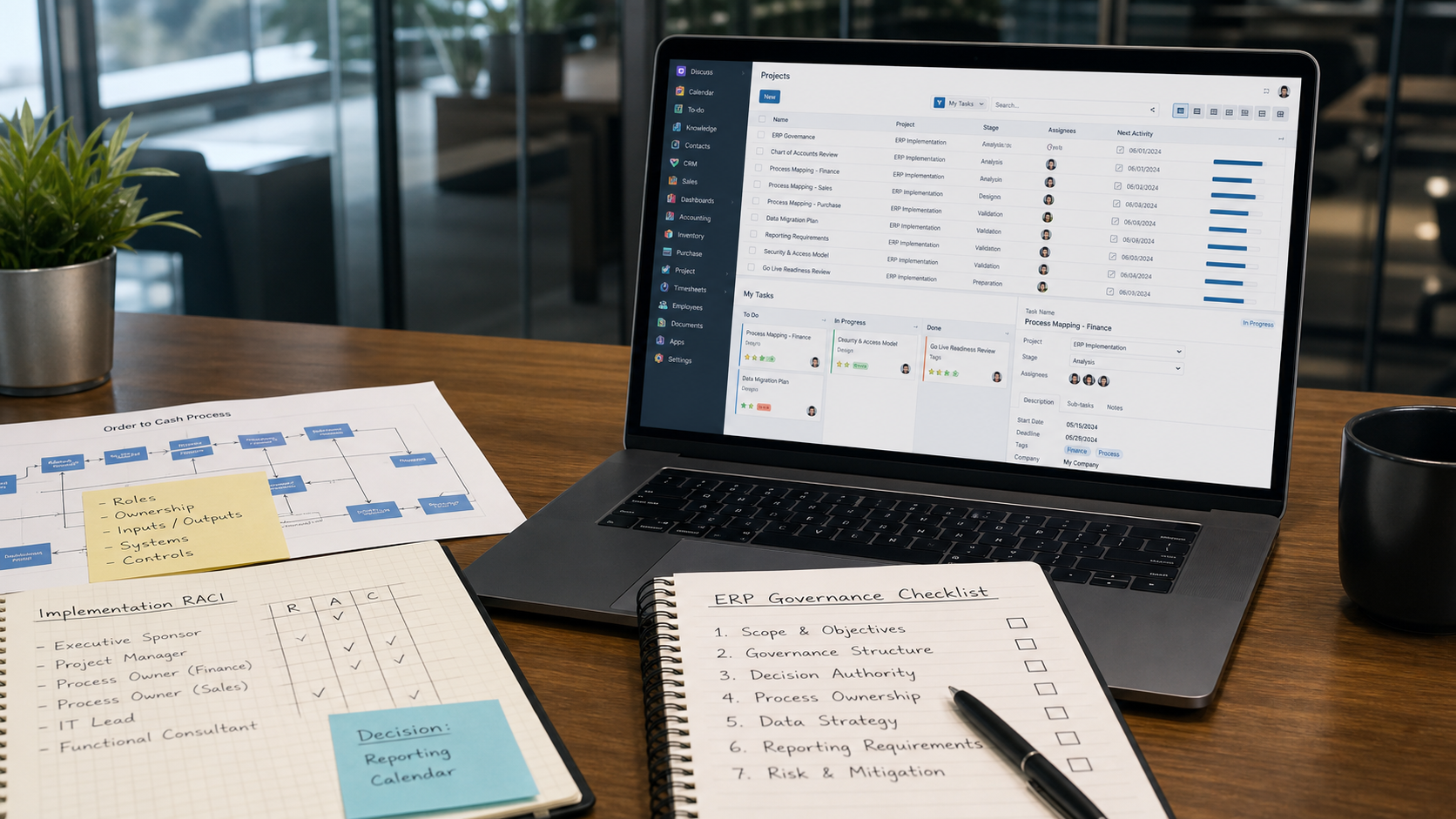
Many Odoo projects look healthy right up to the point where users start working around the system.
That usually happens because configuration moved faster than the business decisions underneath it. Screens were built. Modules were activated. Data was loaded. But the real questions were still unresolved: how the process should actually work, who owns each decision, what exceptions are allowed, and what the business expects people to do after go-live.
Odoo is powerful. That is exactly why weak governance becomes expensive so quickly.
Why configuration can create false progress
Configuration is visible, so it feels like momentum. You can see workflows, menus, fields, reports, and prototypes taking shape.
The risk is that visible progress can hide unresolved business questions. If those questions are still open, the system may be getting built on top of assumptions that no one has fully agreed.
That is when projects start producing familiar problems.
- Teams say the system “does not fit” even though it technically works.
- Exceptions multiply because the standard process was never defined properly.
- Users keep shadow spreadsheets because the reporting view is not trusted.
- Testing becomes a scramble because no one agreed what “done” should mean.
In other words, the software is moving, but the business is still undecided.
Six decisions to make before configuration runs too far ahead
You do not need every detail fixed before work begins. But there are some decisions that should be clear early.
1. What process should become the standard
If every department does the same thing differently, Odoo will not magically choose the best version for you.
The business needs to decide what the standard process should be for sales, purchasing, stock, fulfilment, finance handoff, approvals, and reporting. Otherwise the implementation becomes a negotiation inside the software.
2. Who owns each process
One of the fastest ways to lose control is to let a process sit between teams with no single business owner.
Every critical flow needs a named owner who can make decisions, approve trade-offs, and resolve conflicts when the implementation hits a grey area.
3. Which exceptions are allowed
Every business has legitimate exceptions. The danger is treating every old habit like a special case that must be preserved.
You need to decide:
- which exceptions are truly necessary
- which ones should disappear
- which ones need approval before they become part of the design
Without that discipline, the system becomes a museum of old workarounds.
4. What must be visible in reporting
If reporting is left until late, teams often discover after go-live that the data structure does not support the management view they expected.
Leaders should be clear about the operational questions the system needs to answer. For example:
- What is late?
- What is blocked?
- What is waiting for approval?
- What is profitable?
- What is not being followed through?
If those questions are clear early, the configuration and data model can support them properly.
5. How testing is approved
Testing should not be a vague feeling that the system “looks okay.”
A useful test approach normally defines:
- who signs off each process
- what evidence counts as a passed test
- what defects block progress
- how unresolved issues are recorded and prioritised
Without this, testing becomes a polite demo cycle instead of proof.
6. What adoption should look like after go-live
Go-live is not the end of the project. It is the start of operational use.
That means the business should already know:
- how users will be trained
- what documentation they need
- who answers questions after launch
- how non-compliance with the new process will be handled
- what first-month reporting will be used to see whether adoption is real
If adoption is assumed rather than designed, the system may go live but still fail commercially.
The warning signs that governance is too weak
You usually do not need a formal audit to notice trouble. The signals show up in the language around the project.
- “We will decide that later.”
- “The partner is handling it.”
- “Each department can keep doing it their own way for now.”
- “We will sort the reports after go-live.”
- “Users will adapt once they see the system.”
Those phrases all point to the same underlying risk: business-side control is too weak.
What a strong business-side review should produce
A useful governance review should leave you with more than a list of complaints. It should produce structure.
- A clearer map of which processes need business decisions first.
- Named owners for the important flows.
- A list of unresolved decisions that are currently blocking good design.
- A realistic view of adoption risk.
- A tighter definition of reporting and testing requirements.
- A clearer line between what the implementation partner is doing and what the business must own.
That changes the project from “software activity” into “business change under control.”
The practical takeaway
The real question is not whether Odoo can support your process. In most cases, it can.
The real question is whether the business has defined the process clearly enough, owned the decisions properly enough, and designed adoption seriously enough for Odoo to become the operating backbone instead of another tool people work around.
If that part is weak, more configuration will not solve it. It will only make the rework more expensive later.